
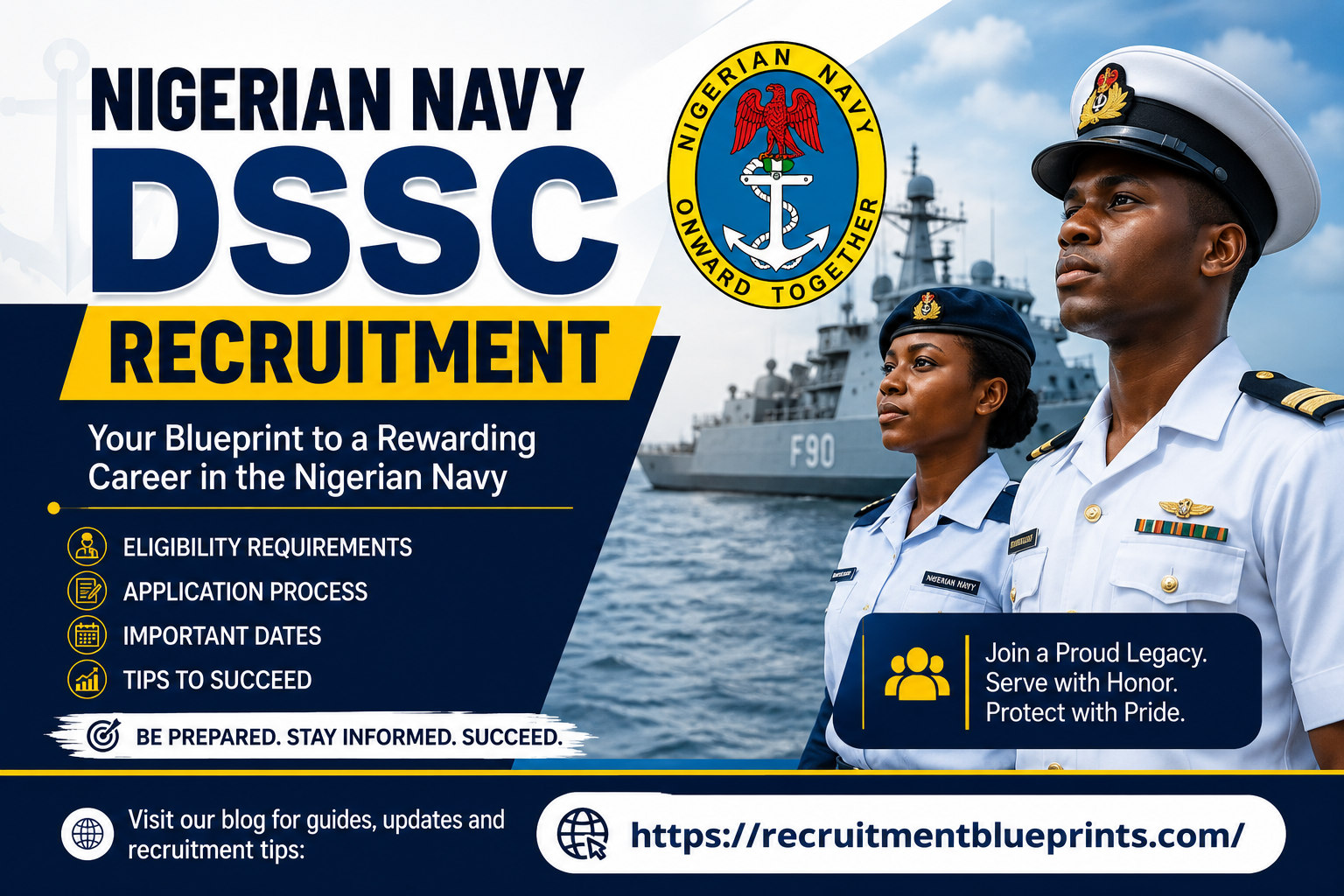

If you finished university or polytechnic and have always felt that ordinary office work is not quite your path, but you also do not want to start a military career completely from the bottom, the Nigerian Navy DSSC programme might be exactly what you have been searching for. DSSC, or Direct Short Service Commission, is the route that allows graduates to enter the Navy directly as commissioned officers rather than as ratings.
In this guide, I will explain what Navy DSSC actually involves, who qualifies, what the application generally requires, and how to prepare properly. I am writing this the way I would explain it to a graduate friend who keeps asking, “but how exactly does a civilian like me become a Navy officer?”
What Nigerian Navy DSSC Recruitment Actually Is
Direct Short Service Commission is a recruitment pathway specifically designed for graduates who already hold a degree or HND and want to join the Nigerian Navy as officers, rather than going through the longer Nigerian Defence Academy route or entering as a rating through general recruitment. Where the NDA route involves up to five years of academy training before commissioning, DSSC compresses this into a shorter officer training programme, recognizing that the candidate already arrives with academic qualifications.
University graduates who go through this route typically enter first as Midshipmen, undergo training at the Nigerian Naval College in Onne, Rivers State, and are then commissioned as Sub Lieutenants once training is successfully completed. This is one of three broad ways to join the Nigerian Navy, alongside the Nigerian Defence Academy degree programme for officers and direct recruitment for SSCE holders entering as ratings.
How Navy DSSC Differs From General Ratings Recruitment
People sometimes confuse DSSC with the general Navy recruitment exercise that brings in Seamen, Survey Recorders, and technical ratings. The key difference is qualification and outcome. General ratings recruitment is open to SSCE, NECO, GCE, or NABTEB holders and leads to enlistment as a rating. DSSC is strictly for graduates and leads directly to officer commissioning. If you have a degree, DSSC is generally the more fitting route, since it recognizes your academic background from day one rather than starting you at entry rating level.
Important Information Every Applicant Should Know
General Eligibility Requirements
Based on recent Navy DSSC exercises, applicants are generally expected to meet the following conditions.
- Must be a Nigerian citizen by birth
- Generally between 22 and 28 years of age, though specific specialist roles such as medical consultants, chaplains, or imams may have a higher upper age limit, sometimes extending to 30 or 35 years
- Must possess a minimum of a Second Class Lower degree or a Lower Credit HND from a recognized institution
- Must hold a valid NYSC discharge certificate or an exemption certificate
- Must be single at the point of application
- Must meet the minimum height requirement, generally around 1.69 metres for males and 1.65 metres for females
- Must be medically, physically, and psychologically fit, with no physical disabilities or visible tattoos
- Must have no criminal convictions
- Must possess a valid National Identification Number, NIN
Training Period and Service Commitment
Training for Navy DSSC candidates typically lasts around six months of intensive military instruction at the Nigerian Naval College, Onne. After successful commissioning, officers generally serve under an initial service tenure that has commonly been estimated between 10 and 15 years, depending on their specific corps and the needs of the Navy at the time. This is worth keeping in mind, since DSSC is a genuine career commitment rather than a short term experience.
Specialization Matters From the Start
Just as with the Army’s DSSC programme, the Navy version is structured around specific professional needs. Depending on the year’s manpower requirements, DSSC intake has covered fields connected to engineering, medical services, communications, and other technical or professional disciplines relevant to naval operations. Choosing a specialization that genuinely matches your degree improves your chances significantly, compared to applying for something unrelated simply because it sounds appealing.
It Is Completely Free
As with every other branch of the Nigerian Armed Forces, Navy DSSC application is free of charge. No legitimate stage of this process requires payment, and the Navy has consistently warned applicants to beware of fraudsters claiming they can help secure shortlisting for a fee.
Official Portal
Official Application Portal: www.joinnigeriannavy.com
Supporting Site: navy.mil.ng
Head of Agency: Vice Admiral Idi Abbas, Chief of Naval Staff
Step by Step Guide: How to Apply for Nigerian Navy DSSC
Step 1: Confirm the DSSC Portal Is Officially Open
Watch the official portal and verified Navy social media channels for the official announcement of a new DSSC intake. Avoid any portal or link that circulates before an official confirmation, since fake versions have appeared in the past during high interest recruitment periods.
Step 2: Visit the Official Portal
Go to www.joinnigeriannavy.com and locate the DSSC section, separate from the general ratings recruitment section.
Step 3: Register an Account
Create an account using a valid email address and your NIN, then set a secure password for your application.
Step 4: Complete Your Personal and Educational Details
Fill in your personal information, academic qualifications, and your chosen specialization or corps. Make sure your details match your certificates exactly, since inconsistencies between your form and your documents can cause problems later.
Step 5: Upload Required Documents
Commonly requested documents for DSSC applications include your degree certificate or HND, NYSC discharge or exemption certificate, birth certificate or statement of age, certificate of state of origin, and a valid means of identification. Use clear scans rather than blurry images.
Step 6: Review and Submit Your Application
Go through every section carefully before final submission. Submitting multiple applications or inconsistent information across sections can lead to disqualification.
Step 7: Print Your Acknowledgment Slip
After successful submission, print your confirmation or acknowledgment slip and keep it safe, along with your login details, for future reference.
Step 8: Prepare Physical Forms Once Shortlisted
If shortlisted, be ready to print and complete physical forms such as an Applicant’s Declaration, Parent or Guardian Consent, LGA Certification, Police Clearance, and a Guarantor’s Form, since these are typically required at the interview stage in addition to your originally uploaded documents.
A Practical Example
Consider Tobi, a mechanical engineering graduate who completed his NYSC the previous year. He has always admired the discipline of military life but did not want to spend years in the Defence Academy given his existing degree. When Navy DSSC was announced, he confirmed his age and physical measurements met the requirement, selected the engineering specialization that matched his degree exactly, and gathered his documents early, including a clear NYSC certificate scan and his original degree certificate. Because he matched his specialization correctly to his academic background instead of guessing, his application moved forward without the kind of mismatch issues that disqualify many otherwise qualified graduates.
Common Questions and Answers
What is Nigerian Navy DSSC Recruitment?
It is a recruitment pathway that allows graduates with a degree or HND to join the Nigerian Navy directly as commissioned officers, after training at the Nigerian Naval College in Onne, Rivers State.
What is the age requirement for Navy DSSC?
Generally between 22 and 28 years, though some specialist roles such as medical consultants, chaplains, or imams may have a higher upper age limit, sometimes up to 35 years.
Do I need to pay anything to apply?
No. Navy DSSC application is completely free. Never pay anyone claiming to assist with your application or guarantee your selection.
What is the minimum qualification needed?
A minimum of a Second Class Lower degree from a recognized university or a Lower Credit HND from a recognized polytechnic, along with a valid NYSC discharge or exemption certificate.
How long is the training and service commitment?
Training generally lasts around six months at the Nigerian Naval College, Onne, followed by an initial service tenure commonly estimated between 10 and 15 years, depending on corps and Navy requirements.
Can married applicants apply for Navy DSSC?
Generally, applicants are required to be single at the point of application, so confirm the specific marital status requirement stated when the current intake is officially announced.
Where do I find the official Navy DSSC portal?
The official portal is www.joinnigeriannavy.com. Always confirm any announcement through this site or navy.mil.ng rather than unofficial links shared on social media.
What happens after I submit my DSSC application?
The Navy typically reviews applications before announcing shortlisting for aptitude testing, interviews, and screening. Keep checking your registered email and the official portal for updates.
Conclusion
Nigerian Navy DSSC Recruitment 2026 offers graduates a genuine and respected path into officer level service, putting your degree to direct use rather than starting completely from scratch. The key to a strong application is matching your specialization honestly to your qualification, preparing your documents early, and applying only through the official portal once a new intake is properly announced.
To understand the wider Navy recruitment landscape, you may also want to read our guides on Nigerian Navy Recruitment 2026/2027, covering the application portal and general requirements, as well as our article on Nigerian Navy Shortlisted Candidates, since both connect directly to what happens once your DSSC application moves forward.
