
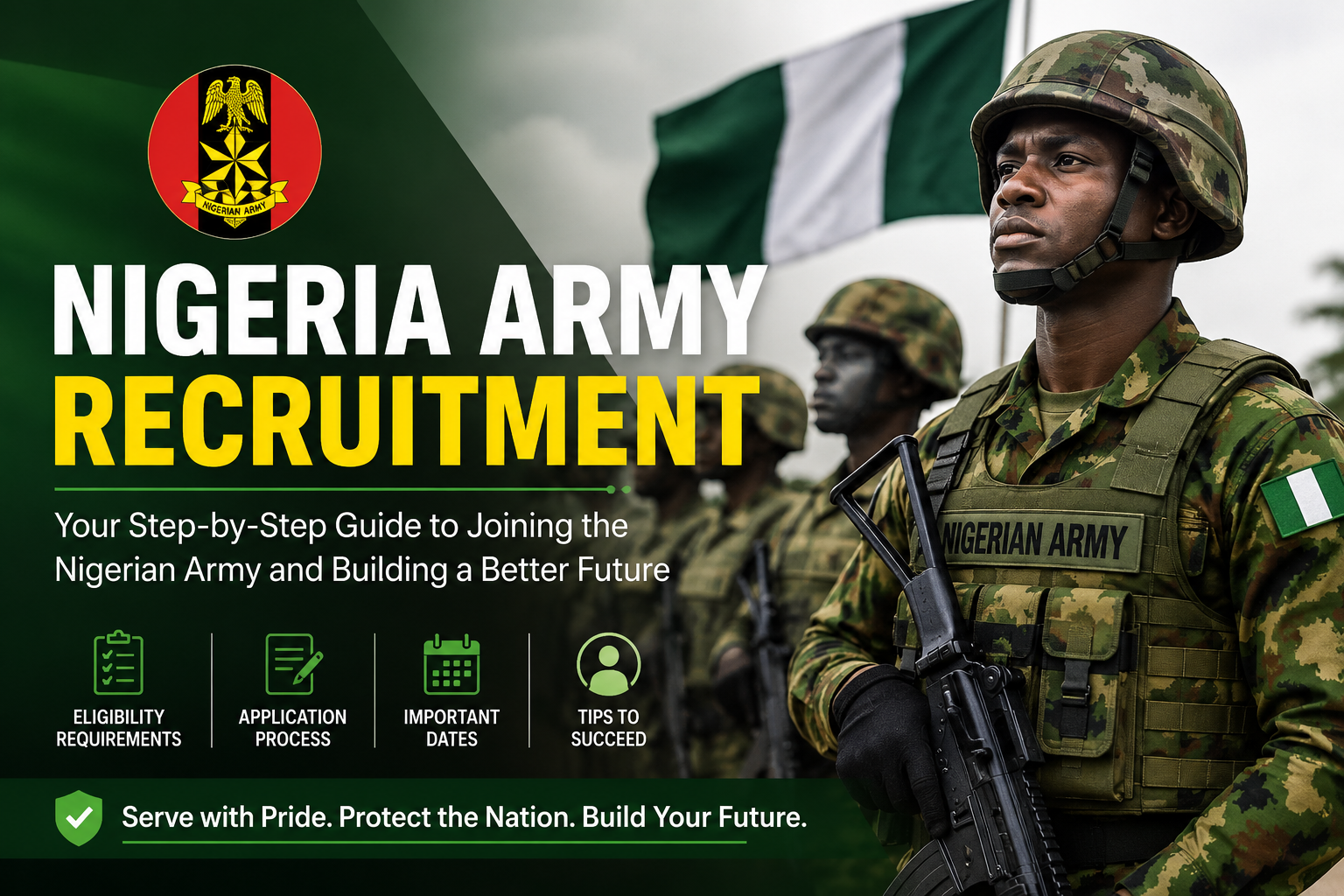
Nigerian Army Recruitment 2026/2027: Application Portal, Form, Requirements & How to Apply

Joining the Nigerian Army remains one of the most sought-after career paths for young Nigerians, and for good reason it offers structure, national service, and a steady career path that many other sectors simply cannot match right now. But because the recruitment process runs in cycles, with portals that open and close at specific times, a lot of applicants end up confused about whether the exercise is currently active, where to apply, and what is actually required of them.
This guide breaks all of that down in plain language. We will look at whether Nigerian Army recruitment 2026/2027 is currently ongoing, where the real application portal is located, what documents you need, the step-by-step application process, and very importantly how to avoid the scammers who prey on desperate job seekers during every recruitment season.
Is Nigerian Army Recruitment 2026/2027 Ongoing?
Here is the honest answer, because too many websites online give vague or recycled information just to attract clicks: Nigerian Army recruitment does not run as one continuous, year-long exercise. Instead, the Army opens specific intakes at specific times of the year, each with its own opening date, closing date, and eligibility rules. There are three major entry routes you should know about:
- Regular Recruits Intake (RRI) — this is for tradesmen, tradeswomen, and non-tradesmen/women with secondary school qualifications who want to join as soldiers.
- Short Service Combatant Commission (SSC) — for graduates and HND holders who want to be commissioned as officers.
- Direct Short Service Commission (DSSC) — for qualified professionals (engineers, medical doctors, signals/IT specialists, and similar fields) who join as commissioned officers in specialised corps.
As of now, the most recent intakes the 91st Regular Recruits Intake (91RRI) and the Direct Short Service Commission Course 29/2026 have already had their online application windows close. The 91RRI portal was open for a few weeks earlier in the year, and shortlisted candidates from that exercise have since been undergoing state-of-origin screening. The DSSC 29/2026 form was also available for a limited window earlier in the year and is no longer accepting new applications.
What this means practically is that there is currently no fresh, brand-new portal open for general public application at the time of writing. This is completely normal the Nigerian Army does not keep its portal permanently open, and a “gap” between intakes is expected. The smartest thing you can do right now is prepare ahead, because the next intake (whether RRI, SSC, or DSSC) could be announced at any time, and when it opens, the window is usually short often just a few weeks.
We will keep this page updated as soon as a new portal opens for the 2026/2027 cycle, so it is worth bookmarking this article rather than relying on memory or random social media posts.
Official Recruitment Portal
There is only one legitimate online portal for Nigerian Army recruitment, and that is:
👉 https://recruitment.army.mil.ng
This is the only website you should trust for any Nigerian Army application whether it is RRI, SSC, or DSSC. The Army also maintains a general information website at army.mil.ng, but actual applications are processed through the recruitment subdomain above. Any other website asking you to “register” or “pay” for a Nigerian Army form is not an official channel, no matter how convincing it looks. We will explain more about spotting fake portals later in this article.
How the Portal Works
When recruitment is open, the portal homepage usually displays the active intake (for example, “91 Regular Recruit Intake” or “DSSC Course 29/2026”) with a clickable link or button to begin registration. If you visit the portal and there is no active intake banner, it simply means applications are not open at that moment it does not mean the website is fake or broken.
Available Positions in Nigerian Army Recruitment
Depending on which intake is open, the Nigerian Army recruits into different categories. Understanding these helps you know which one actually fits your qualifications instead of wasting time applying for the wrong category.
1. Non-Tradesmen and Non-Tradeswomen
This is the general soldier entry point under the Regular Recruits Intake. It is open to candidates with a Secondary School Certificate (WASSCE, NECO, GCE, or NABTEB) and does not require a specific trade skill.
2. Tradesmen and Tradeswomen
This category is for candidates who, in addition to their secondary school certificate, also hold a Trade Test or City and Guilds certificate in areas such as carpentry, plumbing, welding, electrical work, mechanics, and similar vocational skills. The Army needs these hands-on skills to keep its barracks, equipment, and operations running.
3. Short Service Combatant Commission (SSC)
This route is for graduates with a Bachelor’s degree or HND who want to be commissioned directly as combat officers, rather than entering as soldiers first.
4. Direct Short Service Commission (DSSC)
DSSC targets professionals in specific fields the Army needs at any given time past intakes have included corps such as the Nigerian Army Engineers, Nigerian Army Signals, Nigerian Army Medical Corps, Nigerian Army Electrical and Mechanical Engineers, and the Nigerian Army Education Corps. This route is open to both civilians and serving military personnel who already hold relevant qualifications.
If you are unsure which category fits you, it usually comes down to your highest qualification: secondary school leavers and tradespeople look toward RRI, while degree and HND holders should consider SSC or DSSC depending on whether they have a specific professional skill the Army is recruiting for at that time.
Requirements for Nigerian Army Recruitment
While specific requirements can shift slightly from one intake to another, certain core eligibility conditions have remained fairly consistent across recent Nigerian Army recruitment exercises. Here is what you generally need to qualify:
Citizenship and Personal Status
You must be a Nigerian citizen by birth. For the Regular Recruits Intake, you must also be single married applicants are not eligible for that particular category. You must have a National Identification Number (NIN) and a Bank Verification Number (BVN), and the name and date of birth on both must match each other and every other document you submit.
Age Limits
Age requirements differ by category. For non-tradesmen/women under RRI, applicants are typically expected to fall between 18 and 22 years old at the time of application. Tradesmen/women generally have a slightly wider window, often up to around 26 years. For SSC and DSSC, the age range is usually higher, reflecting the fact that these candidates already hold tertiary qualifications – DSSC age limits have, in past cycles, stretched as far as the early thirties, with slightly higher allowances for specialist roles like medical consultants. Always check the specific age requirement stated for the intake you are applying for, since this is one of the first things that can disqualify an otherwise strong applicant.
Educational Qualification
For RRI, you need at least four credits, including English Language, obtained in not more than two sittings of WASSCE, NECO, GCE, or NABTEB. Tradesmen and tradeswomen additionally need a relevant Trade Test or City and Guilds certificate. For SSC, a Bachelor’s degree or HND is required. DSSC applicants generally need a First Degree or HND in a field relevant to the corps they are applying for, along with any professional licences or registrations where applicable.
Physical Standards
The Army has strict height requirements: male candidates are usually expected to be at least 1.68 metres tall, while female candidates need to be at least 1.65 metres. Beyond height, applicants must be medically, physically, and psychologically fit according to Nigerian Army medical standards. This is checked thoroughly during the screening stage, so it is not something you can fake your way through.
Character and Conduct
You must have no criminal conviction from any competent court. Applicants are also typically required to provide guarantors often a local government chairman, a senior civil servant, or an officer in the armed forces or police not below a specified rank who can vouch for their character.
One thing worth explaining clearly: applying using your state of origin (not your state of residence) matters a lot, because shortlisted candidates report for screening in their state of origin. Many applicants have been disqualified simply for filling in the wrong state, so this is not a small detail to overlook.
Documents Needed for Application
Before you even open the portal, it helps to have these documents ready in scanned or photographed form, since the online form usually requires uploads:
- Valid means of identification (National ID slip showing your NIN)
- Bank Verification Number (BVN) slip
- Birth certificate or age declaration (sworn affidavit)
- Educational certificates — WASSCE/NECO/GCE result for RRI applicants, or degree/HND certificate and NYSC discharge or exemption certificate for SSC/DSSC applicants
- Trade Test or City and Guilds certificate (for tradesmen/women only)
- Certificate or evidence of state of origin/indigene certificate
- Recent passport photographs
- Guarantor’s form, properly signed and stamped by an eligible referee
- Any professional licence relevant to your field, where applicable (for example, medical practising licences for DSSC medical applicants)
A common mistake here is uploading blurry or cropped images of certificates. Take the time to scan documents properly a rejected upload at this stage can cost you the entire application, especially since portals usually do not allow resubmission once you have finalised your form.
How to Apply for Nigerian Army Recruitment
Once a new intake is officially announced and the portal is active, here is the general process you should expect to follow:
Step 1: Confirm the Announcement Is Genuine
Before doing anything else, verify that the recruitment announcement is coming from an official Nigerian Army channel their verified social media handles, official press statements, or radio and television jingles. Do not act on information shared in random WhatsApp or Telegram groups without confirming it first on the official portal.
Step 2: Visit the Official Portal
Go directly to https://recruitment.army.mil.ng. Avoid clicking links shared by strangers; type the address yourself or use a link from a verified news source.
Step 3: Select Your Category
Choose the intake category that matches your qualification RRI, SSC, or DSSC and read the eligibility criteria for that specific category carefully before proceeding.
Step 4: Register and Create Your Profile
If it is your first time, you will typically need to sign up with a valid email address and active phone number. A verification code or link is usually sent to confirm these details, so make sure you use contact information you can actually access throughout the process.
Step 5: Fill in Your Personal and Educational Details
Complete the form with accurate information — your bio-data, state of origin, educational background, and next-of-kin details. Double-check every entry against your NIN and BVN, since mismatched details are one of the leading causes of disqualification.
Step 6: Upload Your Documents
Upload the documents discussed earlier in the required format and size. If the portal specifies a maximum file size or particular file type (like PDF or JPEG), stick to it exactly.
Step 7: Review and Submit
Go through every section once more before clicking submit. Once submitted, most portals do not allow further editing, so this review step is not something to rush.
Step 8: Print Your Application Slip
After successful submission, print out your application slip or confirmation page. You will likely need this if you are shortlisted for screening.
Step 9: Monitor the Portal for Updates
Keep checking your email and the recruitment portal regularly for updates on shortlisting, screening dates, and venues.
Important Things Applicants Should Know
A few practical points that genuinely matter, based on how past recruitment cycles have played out:
The application is completely free. The Nigerian Army has repeatedly stated, through official channels, that no fee is charged at any stage of registration. If anyone online or offline asks you for money to “process,” “fast-track,” or “guarantee” your application, that is a scam, full stop.
Apply with your state of origin, not your state of residence. This single detail trips up more applicants than almost anything else, because screening venues are organised by state of origin.
Multiple applications can disqualify you. Submitting more than one application, or providing conflicting information across forms, has led to outright disqualification in previous cycles.
Document verification is thorough. All certificates are checked with the relevant issuing bodies (WAEC, NECO, universities, and so on). Anyone caught with forged documents risks being handed over to the police, not just losing the job opportunity.
Recruitment is competitive, not guaranteed. Meeting the basic requirements gets you into the pool of candidates; it does not automatically mean you will be selected. Treat the screening and selection stages with the same seriousness as the application itself.
Physical fitness matters from day one. Screening typically includes physical tests, so it helps to start building stamina running, push-ups, and general fitness well before you are invited.
Recruitment Closing Date
This is one area where you should never trust a fixed date you find on a random blog, because closing dates change with every intake. As context: the most recent DSSC Course 29/2026 ran for about four weeks earlier in the year, while the 91RRI application window also lasted a few weeks before screening began. There is no current open window for general application as of now, and we cannot predict the exact date the next portal will open or close, since this is solely at the discretion of the Nigerian Army.
What we can tell you with confidence is the pattern: portals tend to stay open for a relatively short period typically a few weeks and late submissions are not entertained once the deadline passes. The best strategy is not to wait for an exact date but to have your documents ready in advance so that whenever the next portal opens, you can apply within the first few days rather than rushing at the last minute.
How to Avoid Recruitment Scams
Every recruitment season, fraudsters try to exploit job seekers, and Nigerian Army recruitment is one of their favourite targets because of how much interest it generates. Here is how to protect yourself:
Never Pay for an Application Form
The Nigerian Army has stated clearly, on multiple occasions, that its recruitment process is free. Anyone selling “forms” or asking for payment to “assist” with your application is not affiliated with the Army.
Stick to the Official Portal Only
Always type or verify the URL yourself: https://recruitment.army.mil.ng. Be suspicious of look-alike websites with slightly different spellings or extra words in the domain name.
Be Wary of “Guaranteed Selection” Promises
No legitimate official can guarantee your selection in exchange for money or favours. Recruitment is merit-based, and anyone claiming otherwise is attempting to defraud you.
Verify Before You Trust Social Media Posts
Screenshots and forwarded messages spread quickly on WhatsApp and Facebook during recruitment season, and not all of them are accurate. Cross-check any announcement against the Army’s verified social media handles or established news outlets before acting on it.
Report Suspicious Activity
If someone approaches you claiming to help you “secure a slot” for a fee, it is worth reporting them, both to protect yourself and to warn other applicants.
Frequently Asked Questions
Is Nigerian Army recruitment currently open in 2026/2027?
At the time of writing, the most recent intakes — the 91st Regular Recruits Intake and DSSC Course 29/2026 have already closed their application windows. There is no fresh general application currently open, but a new intake can be announced at any time, so it is worth checking the official portal regularly.
Where is the official Nigerian Army recruitment portal?
The only official portal is https://recruitment.army.mil.ng. Applications are never processed through any other website, blog, or third-party link.
Is Nigerian Army recruitment free?
Yes. The Nigerian Army has stated repeatedly that the application process does not require any payment. Anyone asking for money is not a legitimate part of the process.
What qualifications do I need to join the Nigerian Army?
It depends on your chosen route. A Secondary School Certificate with the required credits qualifies you for the Regular Recruits Intake, while a Bachelor’s degree or HND is needed for the Short Service Combatant Commission and Direct Short Service Commission routes.
What is the height requirement for Nigerian Army recruitment?
Male applicants are generally required to be at least 1.68 metres tall, while female applicants need to be at least 1.65 metres tall.
Can married candidates apply for Nigerian Army recruitment?
For the Regular Recruits Intake specifically, applicants are generally required to be single. Marital status requirements can differ for officer-entry routes like SSC and DSSC, so it is important to check the specific criteria published for each intake.
How will I know when the next portal opens?
The Army typically announces new intakes through its official website, verified social media handles, and radio or television jingles. Following these channels and checking back here for updates is the safest way to stay informed.
What documents should I prepare before applying?
Have your NIN, BVN, birth certificate or age declaration, educational certificates, state of origin certificate, passport photographs, and a properly signed guarantor’s form ready before the portal opens.
Does applying guarantee that I will be selected?
No. Meeting the eligibility requirements only qualifies you to be considered. Selection depends on screening performance, document verification, and the number of available slots for that particular intake.
Conclusion
Nigerian Army recruitment remains one of the most credible career routes available to Nigerian job seekers, but success in this process depends heavily on preparation, attention to detail, and patience. Right now, the most recent application windows have closed, but that should not discourage you it is actually the best time to get your documents in order, work on your physical fitness, and make sure your NIN and BVN details match perfectly, so that you are ready the moment a new intake is announced.
Stay clear of anyone asking for money in connection with this process, rely only on the official portal at recruitment.army.mil.ng, and verify any announcement before you act on it. Bookmark this page so you can check back for updates on when the next Nigerian Army recruitment 2026/2027 intake officially opens we will update it as soon as fresh, verified information becomes available.
