
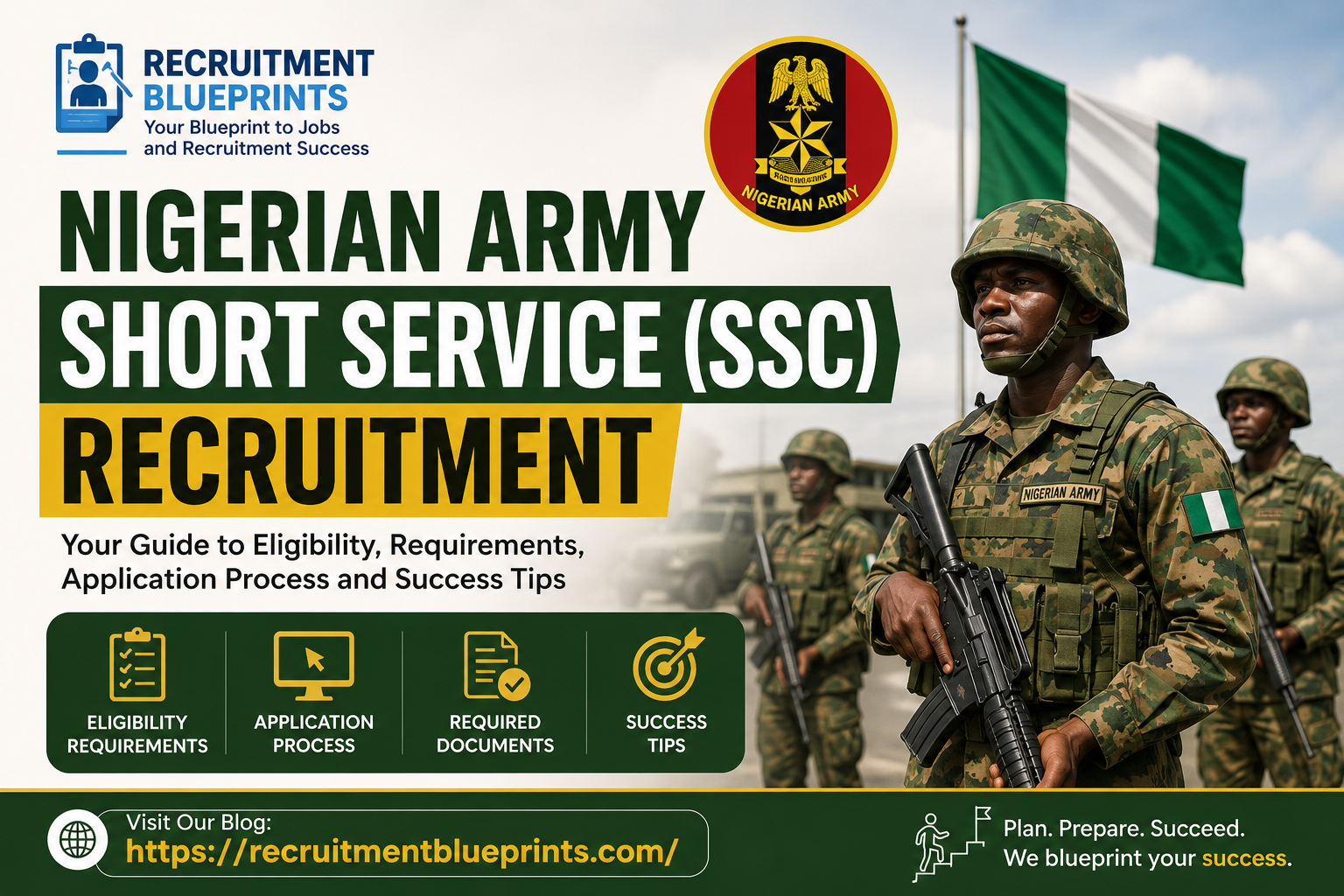

Every year, thousands of Nigerian graduates search for one specific opportunity, a way to become a commissioned officer in the Nigerian Army without spending years climbing the ranks from the bottom. That opportunity is the Short Service Commission, popularly known as SSC. If you have a degree and you have been wondering whether the army actually has a place for graduates like you, this article will answer that question properly.
I will break this down the way I would explain it to a close friend who just finished NYSC and keeps asking questions in our group chat. No confusing military jargon, no copying and pasting from one site to another, just a clear explanation of what SSC is, what it takes to qualify, and how the application actually works.
What Nigerian Army SSC Recruitment Actually Is
SSC stands for Short Service Commission. It is a recruitment route designed specifically for graduates who want to join the Nigerian Army as commissioned officers, with a focus on combatant roles rather than the specialized technical positions that DSSC tends to target. In other words, while DSSC often pulls in engineers, doctors, and signal experts for specific corps, SSC is generally built for graduates who want the broader officer career path, similar in spirit to the regular officer cadet route, but compressed into a shorter and more direct entry process.
Think of SSC as the graduate version of becoming an army officer. You do not need a connection to a military academy or years of preparation through Cadet College. As long as you meet the academic and physical requirements, you can apply directly through the recruitment portal.
How SSC Differs From DSSC
People often mix up SSC and DSSC because both run side by side and both target graduates. The main difference comes down to purpose. DSSC is generally for professionals whose specific qualifications, such as medicine, engineering, or signals, are needed to fill specialized technical corps. SSC, on the other hand, is broader and leans more toward combatant officer roles, similar to what regular officers do, just entered through a shorter commissioning process. The age range for SSC also tends to run slightly younger and narrower compared to DSSC, since combatant roles place heavier emphasis on physical fitness over many years of service.
Important Information Every Applicant Should Know
Recent Application Timeline
For the most recent exercise, the Nigerian Army SSC recruitment portal opened for online registration on Wednesday, 7th January 2026, and continued through Wednesday, 4th February 2026. This ran alongside the DSSC application window, since both programmes are typically announced and processed together on the same portal. If you are reading this outside that window, do not panic. The Nigerian Army runs SSC on a fairly regular yearly cycle, so the structure explained here will still apply once the next course is officially announced.
Eligibility Requirements
Based on the official criteria from recent SSC exercises, applicants are generally expected to meet the following.
- Must be a Nigerian citizen by birth, as defined under the constitution
- Must generally be between 23 and 28 years of age, though specific cut offs are confirmed at the time each course is announced
- Must possess a minimum of a Second Class Lower degree from a recognized university or a Lower Credit HND from a recognized polytechnic
- Must have completed the NYSC scheme, or hold a valid exemption letter
- Must be medically, mentally, and physically fit, with no criminal record
- Must meet the height requirement, generally not less than 1.68 metres for males and around 1.65 metres for females
- Must have no tattoos or body inscriptions beyond recognized tribal marks
- Must not have any of the disqualifying physical conditions the army screens for, such as bow legs, flat feet, knock knees, or defective eyesight
There Is a Written Examination
Unlike the Regular Recruits Intake, where there is currently no pre selection CBT, SSC candidates who pass the initial screening are typically required to sit a written examination at selected examination centres. These centres may be chosen by the applicant during registration or assigned based on location. This is one detail many first time SSC applicants overlook, assuming the process ends at document verification. In reality, performing well on this written exam matters just as much as having the right documents.
It Is Completely Free
As with every other Nigerian Army recruitment exercise, SSC registration does not require any payment. The form, the screening, and the entire selection process are free. If anyone contacts you claiming they can secure your slot or fast track your selection for a fee, that person is attempting to scam you, and you should ignore them completely.
Application Happens Alongside DSSC on the Same Portal
A practical detail worth knowing is that SSC and DSSC share the same recruitment portal at recruitment.army.mil.ng, with separate sections for each programme. When the portal opens, you simply select whichever option matches your career goal. Choosing the wrong one, or applying for both without a clear strategy, can create confusion during verification, so decide early which path genuinely suits you.
Step by Step Guide: How to Apply for Nigerian Army SSC
Step 1: Confirm the Course Is Officially Open
Check the official portal at recruitment.army.mil.ng or listen for radio and television jingles confirming that the current SSC course has been announced. Avoid any portal or link that appears before the official confirmation, since fake versions sometimes circulate online ahead of genuine announcements.
Step 2: Visit the Portal and Select SSC
On the homepage, locate the SSC option and carefully read through the qualification criteria listed for your intended course before proceeding.
Step 3: Create Your Account
Click “Apply Now” under the SSC section. If you do not already have an account, select “Sign Up.” A verification link will be sent to your email, which you must use to verify your account before logging in.
Step 4: Fill In Your Personal and Academic Details
Complete your personal information, educational background, and any other required fields. Confirm that every detail matches your official documents exactly, since inconsistencies can cause problems later in the process.
Step 5: Upload Required Documents
Typical documents requested include your degree certificate or HND, NYSC discharge certificate or exemption letter, birth certificate or statement of age, certificate of state of origin, and a valid government issued ID. Upload clear scans rather than blurry phone pictures, since unreadable documents can affect your screening.
Step 6: Choose Your Preferred Examination Centre
If the portal allows you to select an examination centre, choose one that is realistically convenient for you to travel to on the scheduled date, rather than picking based on assumption or convenience for someone else.
Step 7: Review and Submit
Go through every section of your application carefully before submitting. Submitting multiple applications or providing conflicting information across sections can lead to automatic disqualification.
Step 8: Print Your Acknowledgment Slip
After successful submission, print your online generated photo slip or acknowledgment slip. Keep it safe, since you will likely need it when reporting for the written examination or later screening stages.
A Practical Example
Take Daniel, a 25 year old accounting graduate who completed his NYSC the previous year and has always wanted a structured career with clear progression. When the SSC portal opened in January, he confirmed his height and physical condition met the requirements, gathered his degree certificate, NYSC certificate, and state of origin certificate ahead of time, and selected an examination centre close to his current location rather than his hometown, since he knew travelling far on exam day could affect his performance. By preparing early and choosing practical options rather than convenient guesses, Daniel avoided the last minute stress that affects many applicants who rush through the process in the final days before the deadline.
Common Questions and Answers
Is the Nigerian Army SSC Recruitment 2026 portal currently open?
The most recent SSC course ran online registration from 7th January 2026 to 4th February 2026. If you are checking outside this window, monitor the official portal for the next announcement, since SSC typically runs on a yearly basis.
What is the difference between SSC and DSSC?
SSC generally targets graduates seeking combatant officer roles, while DSSC is focused on professionals whose specific qualifications, such as engineering or medicine, are needed for specialized technical corps. Age ranges and selection focus also differ slightly between the two.
Do I need to pay any money to apply for SSC?
No. The Nigerian Army SSC application is completely free at every stage. Never send money to anyone claiming to assist with registration or guarantee your selection.
Is there an exam involved in SSC recruitment?
Yes. Candidates who pass the initial screening are generally required to sit a written examination at selected examination centres, either chosen during registration or assigned based on location.
What is the minimum qualification needed for SSC?
Generally, a minimum of a Second Class Lower degree from a recognized university or a Lower Credit HND from a recognized polytechnic, along with completed NYSC or a valid exemption letter.
Can I apply for SSC if I have a tattoo?
Visible tattoos or body inscriptions beyond recognized tribal marks generally disqualify a candidate, so this is worth considering carefully before applying.
Where do I find the official SSC application portal?
The official portal is recruitment.army.mil.ng. SSC and DSSC are usually announced together, with separate sections on the same site, so be sure to select SSC specifically when applying.
What happens after I submit my SSC application?
The Nigerian Army typically reviews submitted applications before announcing the next stages, which include the written examination and further screening. Keep checking your registered email and the official portal for updates.
Conclusion
Nigerian Army Short Service (SSC) Recruitment 2026 gives graduates a genuine and structured path into officer level service. Success here comes down to honest preparation, meeting the academic and physical requirements, getting your documents in order early, and taking the written examination stage seriously rather than assuming screening is the final hurdle.
To understand the full Nigerian Army recruitment journey, you may also want to read our detailed guide on the Nigerian Army DSSC Recruitment process, as well as our breakdown of the Nigerian Army Recruitment Screening Date and venue, since both connect directly to what happens after your SSC application is submitted.
